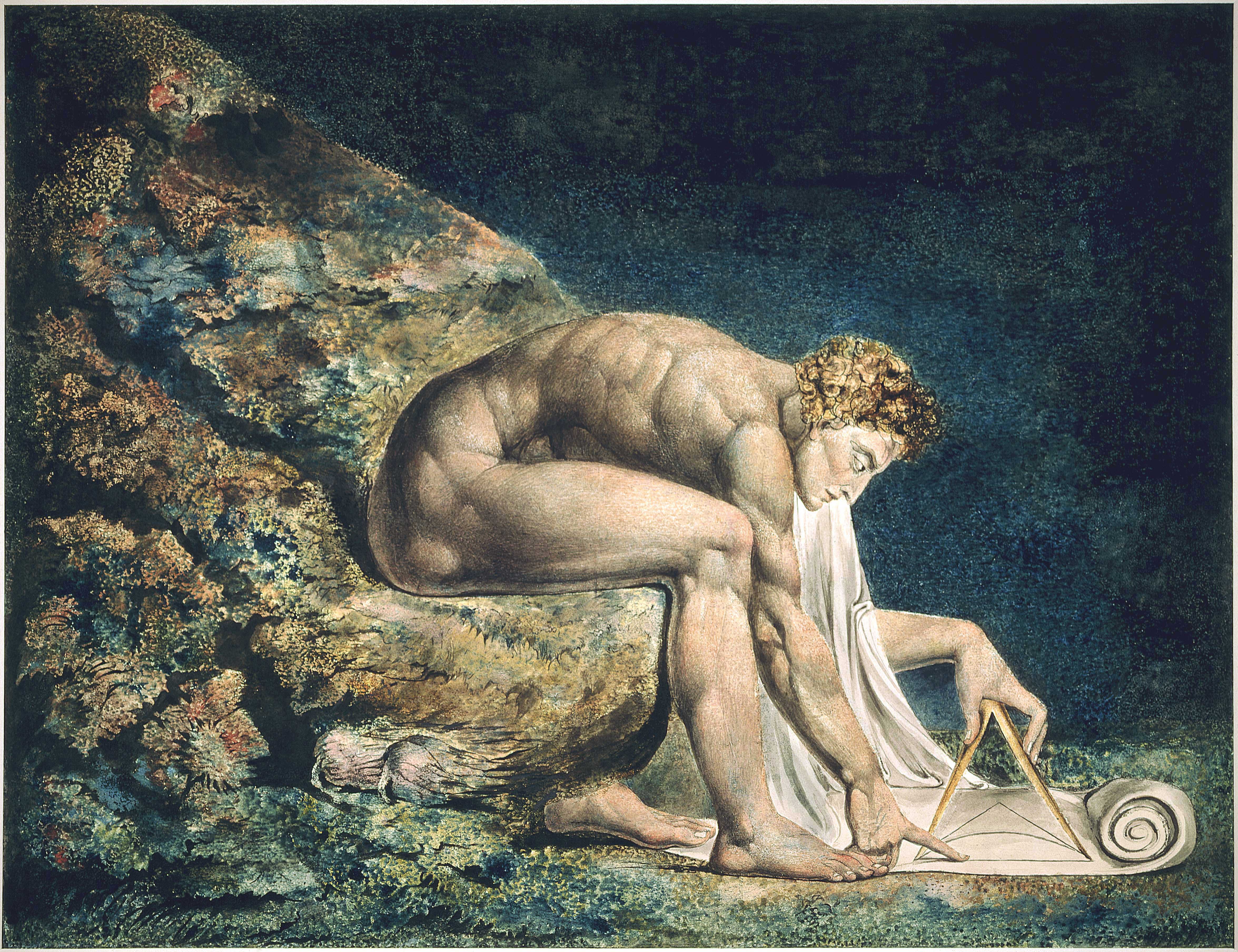
Newton Contra Athanasius
Part I: Newton

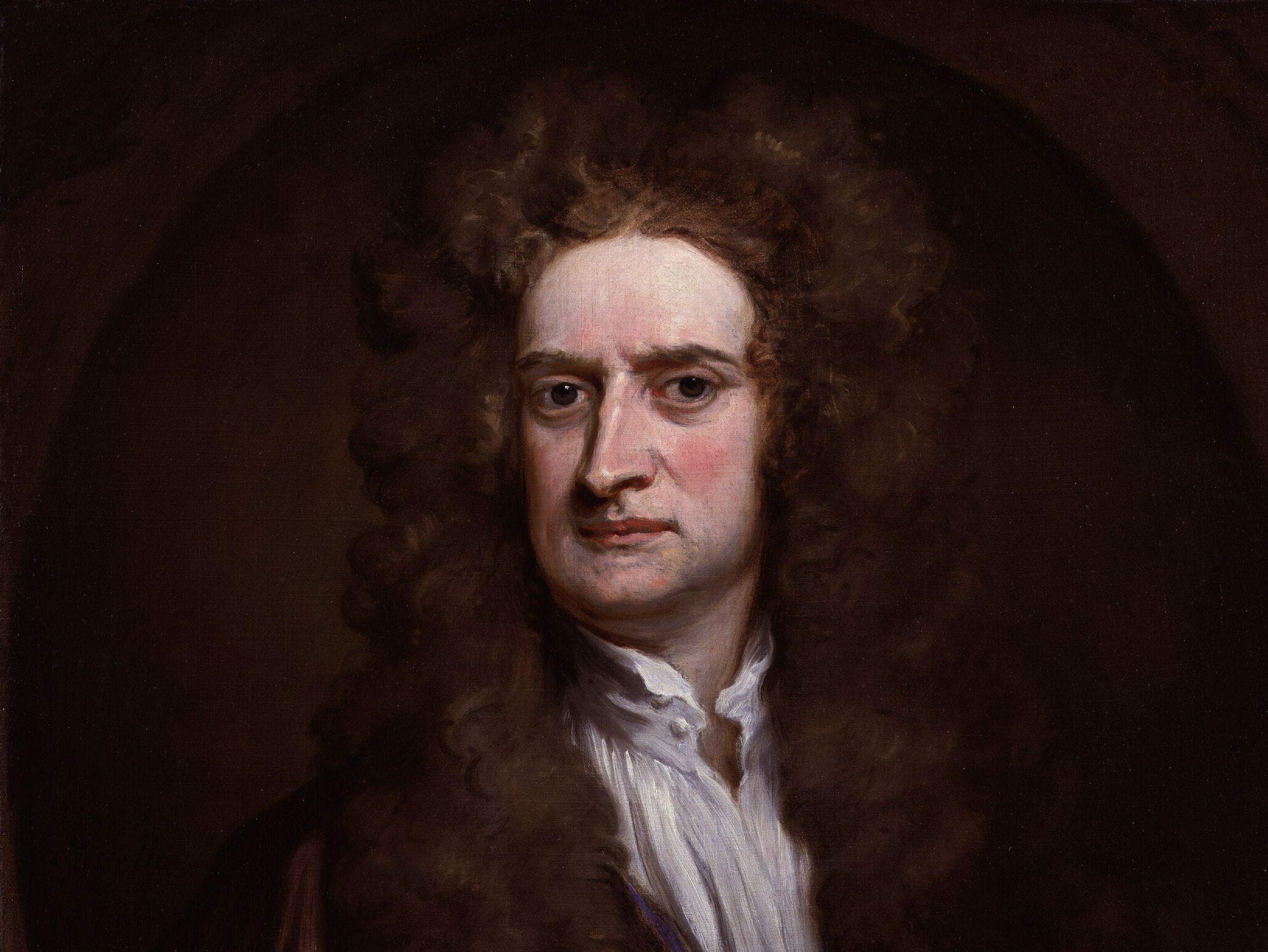
Many of us retain trauma from the times in high school, or even university, when we had to study math, or even worse, physics, propounded by Isaac Newton. A pinnacle genius in the history of science, Newton’s breakthroughs became the foundation of the scientific worldview that is still with us today. Newton and his followers, whether intentionally or not, shattered the old vision of a geocentric universe infused with divine energies acting upon man and for the sake of his salvation, and it put in its place the vast, centerless cosmos of haphazard stars and galaxies.
Rage against this Newtonian cosmos isn’t to be found only among religious fundamentalists. It is shared by many in the postmodern progressive camp who refuse any absolute truths. In my engineering undergrad, I remember us gearheads being herded into a mandatory “elective” seminar where we listened to a series of speakers from exotic fields of study: Christians, philosophers, feminists. I remember a Chinese student waving his hands in outrage in the middle of a lecture in which the feminist speaker called Newton and his ilk rapists, claiming their project was essentially to rape nature (see Carolyn Merchant’s 1980 book The Death of Nature).
Less known about Sir Isaac Newton the scientist is that he made his major breakthroughs in math and science by his mid-twenties, and that the majority of his written investigations thereafter was on other subjects. His most productive time in math and physics was when he was 22 to 24 years old, or years 1665 to 1667, which he spent in cabin fever-induced ruminations, quarantined in his rural home while his school, the University of Cambridge, was closed in response to the Great Plague of London. Most of Newton’s writings after that were on two subjects that, by today’s standards at least, are decidedly un-scientific: alchemy, and theology. About two-thirds of all his surviving writings are of this non-scientific nature.
Newton’s non-scientific writings have been either downplayed or kept secret. They were downplayed for centuries so as not to blemish the myth of the august and infallible scientific genius of the Anglo-Saxons and the Enlightened Secular West. You see, though the scientific pursuit indeed originates in the alchemical one, modern chemistry that arose shortly after Newton exposed its magic-infused precursor as bumbling, nonsensical hocus-pocus, and, what’s worse, motivated by the love of the Filthy Lucre in its doomed central challenge and quest, which was to turn base metals into gold. Reading Newton taking precisely this type of alchemy dead serious in hundreds of thousands of words would tarnish the legend of his genius.
And what to say of Newton’s theology, much of which might embarrass a Deep South Charismatic preacher with all the Young Earth Creationism and trying to calculate the volume of water that was required for the Flood? How could the Modern Scientific Establishment ever explain that about Great Uncle Isaac to the little future astronauts they teach in public schools?
The ADL wouldn’t approve of Newton’s intolerance, either, expressed in sentences such as this: “And in a word, it was the ignorance of the Jews in these Prophecies which caused them to reject their Messiah and consequentially to be not only captivated by the Romans but also to incur eternal damnation.”
The big public disclosure of Newton’s subterranean ruminations occurred only after 1936, two centuries after his death, when John Maynard Keynes, the famous economist, purchased about three million words worth of Newton’s unpublished writings from the family of his great-niece. Having studied his purchase, Keynes the prophet of progressivism famously remarked:
Newton was not the first of the age of reason. He was the last of the magicians, the last of the Babylonians and Sumerians, the last great mind which looked out on the visible and intellectual world with the same eyes as those who began to build our intellectual inheritance rather less than 10,000 years ago.
But there was a simpler reason for Newton to keep his theology private during his lifetime, too. It turns out Newton was a conscious and obstinate heretic. He was an Arian: he denied the Trinity. He was convinced that Jesus Christ was not God, but a being created by God, however supreme, and much of his theological research was geared towards proving this point from scriptures and church history.
Under the blasphemy laws of the day, denying the divinity of one of the persons of Trinity was a criminal offense, punishable with loss of office and imprisonment if repeated. Newton’s colleague William Whiston lost his professorship at Cambridge for this reason in 1711. Earlier, in 1697, Thomas Aikenhead, an eighteen-year-old student charged with denying the Trinity, was hanged at Edinburgh.
Newton’s theology clashed with his worldly career, to say the least. His bachelor’s and master’s degrees from Cambridge required the confession of the Thirty-Nine Articles of the Church of England, which affirmed Trinitarian doctrine. Moreover, his Fellowship at Trinity College at Cambridge, in addition to requiring celibacy, also required the fellows to be ordained into the Anglican priesthood within seven years. Of course, the ordination required confession of the Trinity. Newton was appointed a fellow in 1667, and in 1669, he was appointed to the prestigious Lucasian Professorship of Mathematics at Cambridge. Newton never had a problem with celibacy, but as his Arianism deepened, he vowed to resign from Cambridge rather than profess the Trinity. In the last moment, in 1675, he managed to get a special dispensation from King Charles II that exempted him from the priesthood requirement. The exemption became permanent after Newton.
One of Newton’s notable essays against the Trinity was a posthumously published treatise he titled “Two Notable Corruptions of Scripture.” The first corruption is known as the Johannine comma (here comma means “phrase”). For 1 John 5:7, the King James Bible reads: “For there are three that bear record in heaven, the Father, the Word, and the Holy Ghost: and these three are one.” The original read: “For there are three that testify: the Spirit, the water, and the blood — and these three are in agreement.”
The second corruption is in 1 Timothy 3:16. The KJV reads, “God was manifest in the flesh.” The original was, “he who manifests in the flesh.” Interestingly, only one stroke in the Greek script changes from one version to another: ΘΣ (abbreviation for Θεός / Theos = God) transformed to ΟΣ (ὅς / hos = who). Newton argues for these two corruptions by comparing later translations to ancient Greek manuscripts that contain the original verses. Modern scholarship confirms Newton’s arguments, and orthodox Churches don’t pit their dogma against them. In many languages, the Bible never contained those corruptions, anyway.
Newton considered the Trinitarian doctrine the Great Apostasy and identified it with some dark images in the Book of Revelation, ones that the Protestants of his age were wont to identify with the Catholic Church in general. He pinpointed to the Arian conflict of the 4th century as the historical moment when the apostasy took power.
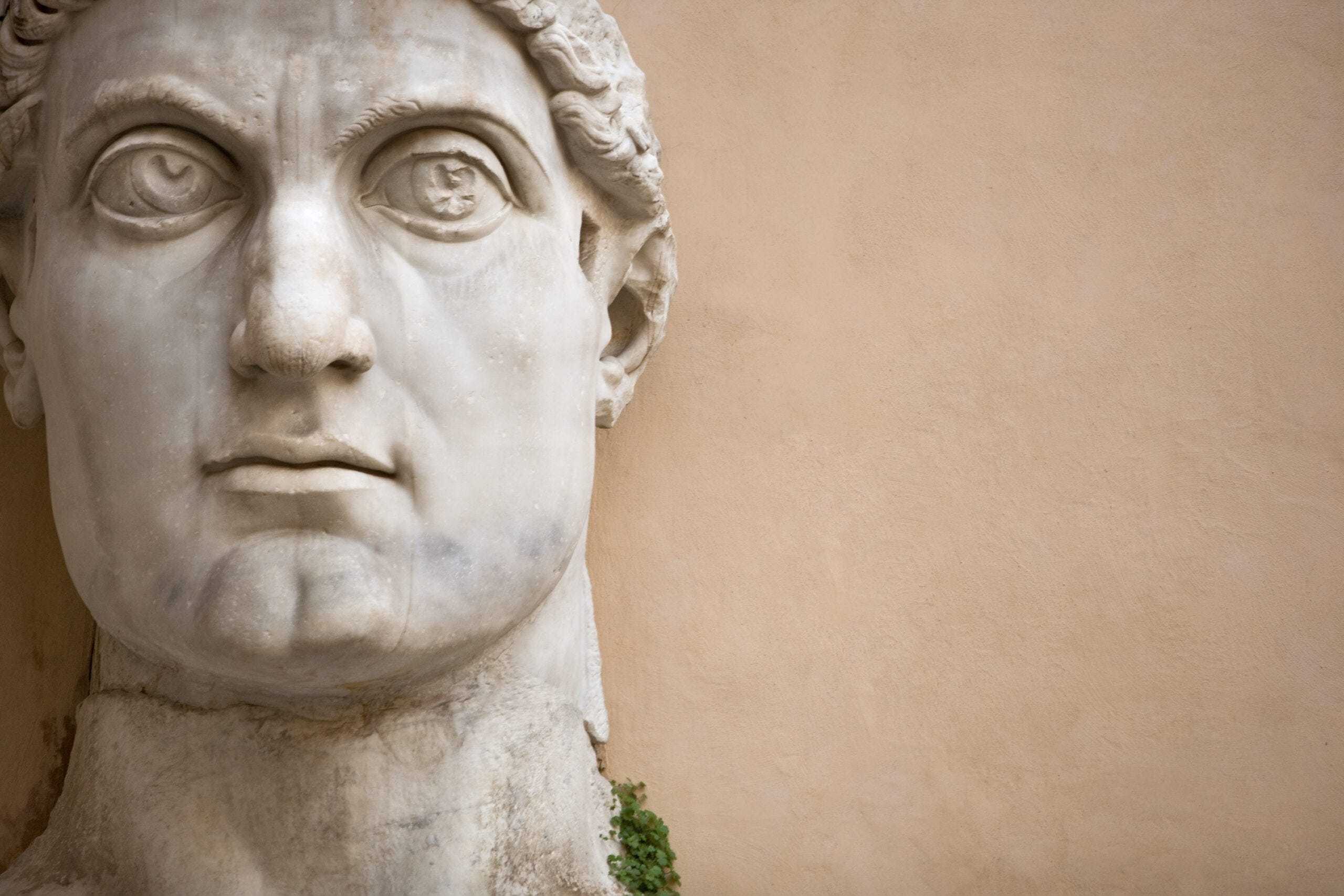
You may know the story. A charismatic priest named Arius, from the metropolis of Alexandria, Egypt, argues that Jesus Christ was not God but a created being, however exalted. “There was a time when he was not,” he says. His stance is condemned by his bishop, Alexander of Alexandria. Nevertheless, his views spread throughout the empire, through catchy songs he himself composed, and caused a split in the Christian community. The Emperor, Constantine, who had recently declared Christianity the official religion of the Empire, is irked that the faith he expected to be a unifying and pacifying force would cause such strife and so soon. He urges both sides of the debate to cease arguing about questions too “sublime and abstruse” for most people.
However, the debate continues to rage, and the emperor calls the first-ever council of the Church in 325 A.D. in Nicaea. The assembled clerics, including Arius, have a debate, and Arius is rebuked by consensus. He’s exiled and excommunicated, though for only a few years, after which he’s restored to communion after publicly recanting his original views. The council meanwhile confirms the doctrine of homoousis, Greek for “same substance”: the Father and the Son are of the same substance. This divine substance is immutable, eternal, etc., so that if the Son shares the substance with the Father, He cannot be created. There cannot be “a time when He was not,” as Arius had proclaimed.
The Arian controversy did not die with the council. The Arian position would regain strength and be backed by subsequent ecclesiastical and imperial establishments. It looked like it would all but become permanent if it wasn’t for but one man – St. Athanasius of Alexandria. He attended the council of Nicaea as a young deacon, under the wing of the same Bishop Alexander who had rebuked Arius in Alexandria. In the subsequent decades, during which Athanasius himself became a respected bishop and scholar in Alexandria, he staunchly defended the doctrine of consubstantiality. For his efforts, he was exiled five times by four different emperors. There were moments when it seemed like Athanasius was alone against the world: Athanasius contra mundi. Yet, he prevailed, and the final doctrine he propounded was formulated in careful detail in the Nicene Creed to exclude Arian and all other heretical deviations. This Nicene Creed, still recited every Sunday in Orthodox and Catholic churches, was formulated in its final form in the Council of Constantinople in 381 A.D., fifty-six years after the first council, and eight years after the passing of Athanasius.
Under Isaac Newton’s pen, Arius was a hero and Athanasius the chief villain. His chief crime against God was the Nicene Creed, the beginning of the formal Apostasy of the Catholic Church, in which general apostasy the Protestant Establishment of his day believed in fervently, even if they retained the belief in the Trinity.
Newton did not refrain from ad hominem attacks on Athanasius, Doctor of the Church and Father of Orthodoxy. He wrote a whole manuscript titled “Paradoxical Questions Concerning the Morals and Actions of Athanasius and His Followers.” He portrays Athanasius as a manipulator who seized Church authority and swayed imperial powers through slander of opponents and forgery of documents. The whole doctrine of homoousis or consubstantiality that Athanasius promoted, and which everyone agrees employs the categories of Platonic-Aristotelian metaphysics, Newton dismisses as heathen metaphysics: “Men skilled in the learning of heathens, Cabbalists and Schoolmen corrupted it with metaphysics, straining the Scriptures from a moral to metaphysical sense and thereby making it unintelligible.”
Moreover, he incriminates Athanasius’ loyalty to the Desert Fathers, the first Christian monks who lived in the Egyptian desert and followed the example and teachings of their founder, St. Anthony the Great. It was this pagan “monkery,” in Newton’s view, that smuggled all sorts of pagan practices into the pristine primitive church, things like irrational esotericism (mostly reflected in testimonies of encounters and struggles with demons) and as veneration or “worship” of saints’ relics, something that Newton like so many other Reformers before and after him characterized as “necromancy.” Newton argues that Athanasius’ loyalty to the monkish desert cult turned him into a fanatic who succeeded in turning the rational and moral primitive church into a corrupt promulgator of superstition.
Having outlined Newton’s Arian (or “Unitarian”) arguments, let’s consider the forces within the Zeitgeist of his time that may have impelled it. These will not be hard to find. Newton was the great synthesizer of the scientific revolution, which had, for a couple of centuries before him, been tending toward a mechanistic vision of the universe that seemed to favor the Unitarian view of God at the expense of the Trinitarian. It did so by undermining Aristotelian physics and metaphysics, the latter of which provided terminology not just for the Nicaean formulation of the Trinitarian doctrine but also the basis for the whole of Scholastic philosophy on which the Medieval Catholic church leaned so trustingly. In its place, it developed a whole new physics and based it on mathematical measurement of mechanical phenomena, such as falling bodies and floating ships. The new rigorous approach proved marvelously accurate, and it exposed the physics of Aristotle and Ptolemy as erroneous and rendered it obsolete.
My serial interlocutor Dr. E. Michael Jones traces the Scientific Revolution to earlier spiritual and philosophical influences at odds with Incarnational philosophy: William of Occam, Kabbalah, the Renaissance. But for the sake of brevity I will here stick to the Scientific Revolution itself as the great surfacing of any subterranean precursors.
Two centuries before Newton, Copernicus placed the Sun rather than Earth in the center of the universe and thus shattered the geocentric model. Galileo rubbed it in with his telescope by showing that the moon was an imperfect flying rock rather than a perfect celestial sphere made of eternal fire, and that the Wandering Stars (“Planets”) are also rocks. Galileo’s descriptions of projectile motion showed that it follows parabolic paths rather than obeying Aristotle’s teleological tendencies (fire goes up, earth goes down, etc.).
René Descartes then made a further break by dividing the universe into purely material bodies controlled by immaterial minds. This duality, which later opened the door to atheism that simply removed the immaterial mind part, worked upon theology too by alienating itself from the idea of the Incarnation as the union of Christ’s divine and human natures in His person, and by extension, of any interpenetration between the spiritual and material realm. Descartes’ philosophy gained cachet thanks to the real and earth-shattering success of the mathematical-geometric revolution he brought about. (Interestingly, Descartes experienced his major breakthroughs in cabin fever, too, ensconced one winter in an overheated room.)
In short, the universe of the new scientists that Newton absorbed as a youth and described in his works was a universe of passive, soulless bodies, corpuscles or atoms whose motion was wholly determined by a set of immutable laws precise enough to be expressed as mathematical equations. These equations Newton tabulated himself in his Three Laws of Motion and his Law of Gravitation. We should see right away that to the extent that God was envisioned as the purely transcendental and dis-incarnate lawgiver, is the extent to which Newton’s scientific theories become more impregnable. Newton had a vested interest in Unitarianism because it made his scientific theories look better.
The explanatory power of Newton’s physics won him immediate and universal acclaim, but it also exposed his system to scrutiny and criticism. Theistic and monist philosophers would use his vision of the mechanical universe to argue that the universe itself is God, or that it contains the whole of transcendence in its self-sufficient mathematical-scientific laws. Leibnitz criticized the force of gravity as “occult” and “inexplicable” (Einstein later called it “spooky action at a distance”). He considered Newton’s explanation of gravity inadequate by the standards of philosophical rigor, an explanatory gap.
Newton responded to his philosophical critics in the General Scholium (i.e., Appendix) to the 2nd edition of his scientific magnum opus, Principia Mathematica. He wrote, “Hypotheses non fingo” – “I feign no hypotheses.” He doesn’t bother about why gravity is; he knows it’s there and can predict how it acts. The phrase encapsulates his rejection of what he considered sterile metaphysical speculation in favor of mathematical determination of observable facts. The attitude would later engender empiricism and then what we now call “scientism” in natural as well as political and social sciences (“I don’t believe in anything without empirical proof”). For Newton himself, framing no hypotheses led him to credit forces at a distance to the direct and free will of God. His Bible-thumping magician persona comes out against the scientific monists and theists in that he considers the Almighty as actively directing the motions of inanimate matter, reserving the right for Himself to alter that motion miraculously as He wishes. As such, his will is not subject to any metaphysical rationalization or physical restraint. The technical name for this position is voluntarism.
In his General Scholium, Newton sets forth his general understanding of God and the universe:
This most beautiful System of the Sun, Planets, and Comets, could only proceed from the counsel and dominion of an intelligent and powerful Being… This Being governs all things, not as the soul of the world, but as Lord over all: And on account of his dominion he is wont to be called Lord God Pantokrator, or Universal Ruler. For God is a relative word, and has a respect to servants; and Deity is the dominion of God, not over his own body, as those imagine who fancy God to be the soul of the world, but over servants.
The supreme God is a Being eternal, infinite, absolutely perfect; but a being, however perfect, without dominion, cannot be said to be Lord God… It is the dominion of a spiritual being which constitutes a God; a true, supreme, or imaginary dominion makes a true, supreme, or imaginary God.
For we adore him as his servants; and a God without dominion, providence, and final causes, is nothing else but Fate and Nature. Blind metaphysical necessity, which is certainly the same always and every where, could produce no variety of things. All that diversity of natural things which we find, suited to different times and places, could arise from nothing but the ideas and will of a Being necessarily existing.
He is utterly void of all body and bodily figure, and can therefore neither be seen, nor heard, not touched; nor ought he to be worshipped under the representation of any corporeal thing… But, by way of allegory, God is said to see, to speak, to laugh, to love, to hate, to desire, to give, to receive, to rejoice, to be angry, to fight, to frame, to work, to build. For all our notions of God are taken from the ways of mankind, by a certain similitude which, though not perfect, has some likeness, however. And thus much concerning God; to discourse of whom from the appearances of things, does certainly belong to Natural Philosophy.
We see here diplomatic rebuttals and hints at every point discussed. Newton’s God is an incorporeal ruler sovereign and domineering in his will. Curiously, we see Newton stating that God should certainly be a subject of the “discourse” of science.
In his book Barren Metal, E. Michael Jones argues that trauma in Newton’s personal life combined with the spirit of the age to compound his bias towards a cold, calculated universe.
Newton’s father died when he was a child. When he was three years old, his mother married a 63-year-old widower, who was also an Anglican priest, out of purely financial considerations. In the prenuptial agreement, Newton’s mother agreed to leave three-year-old Isaac behind to be raised by his grandparents. The Rev. Smith lived longer than Isaac’s mother expected. When she finally moved back to live with Isaac seven years later, she brought three half-siblings with her, and the bond between mother and child was irrevocably broken. Little Isaac had been permanently scarred by the experience. The universe was a different place, ruled by unseen forces that moved bodies in inexplicable ways—ways that a child of undeniable genius could not understand at the time, but which he would attempt to explain in later life.
Jones quotes Newton’s biographer Richard S. Westfall:
Newton was a tortured man, an extremely neurotic personality who teetered always, at least through middle age, on the verge of breakdown. No one has to stretch credulity excessively to believe that the second marriage and departure of his mother could have contributed enormously to the inner torment of the boy, already perhaps bewildered by the realization that he, unlike others, had no father.
Isaac Newton’s origin story paints the stereotypical picture of a tortured genius. A boy cruelly and inexplicably trampled by fate grows up with a manic need to create a world that can be explained and controlled, a world where emotions like love and hate are marginalized. Newton insists that we speak only allegorically about God, we only project our own feeble humanity onto Him, when God is said “to laugh, to love, to hate, to desire, to give, to receive, to rejoice, to be angry, to fight”.
A loving God is dismissed in favor of the distant overlord who acts with impersonal force upon his clattering creation. Jones writes: “The first and most unmistakable conclusion that [Newton] deduced from his mother abandoning him is that human beings are atoms which proceed through life alone and at the mercy of impersonal forces.”
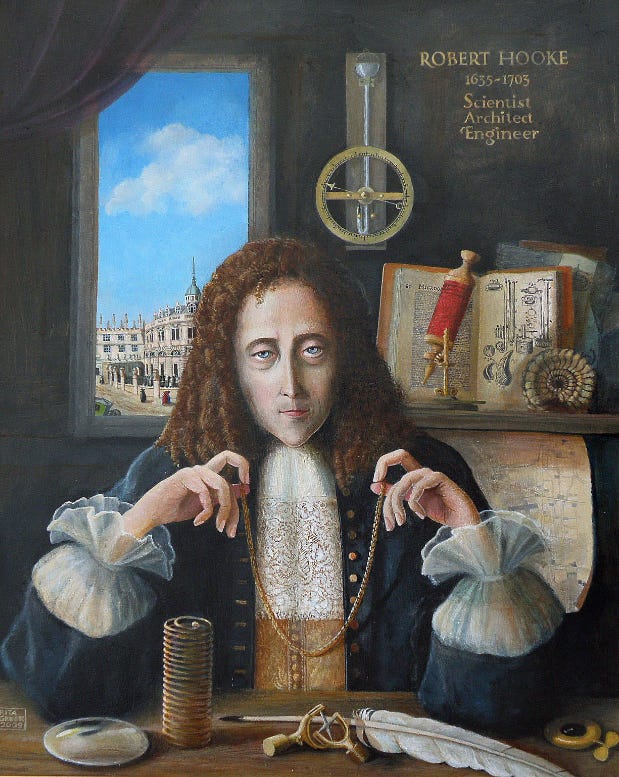
Newton’s neurotic personality manifested in his famous feuds with rival scientists and philosophers. A great scientific breakthrough is necessarily a great synthesis of existing knowledge, for life is too short for any single man to start and end a new science all on his own. The fact is that, though stunning in their synthesis, all of Newton’s physical laws have been mentioned in the works of his predecessors: the several laws of motion in Galileo and Descartes, and the gravitational “inverse-square” law in the works of Robert Hooke. It was in a letter to Hooke that Newton wrote: “If I have seen further, it is by standing on the shoulders of giants.” Newton had long and bitter feuds with Hooke over who first came up with the inverse-square law of gravity, and over theories of optics (light and colors), and with Gottfried Leibniz over who first invented (or discovered) calculus. I’ve met many professors and read many historians who took the sides of Newton’s adversaries in these disputes, and who’d agree that Newton had a petty and vindictive side.
Moreover, Jones argues that Newton’s childhood trauma marked his attitude towards money.
Newton also learned from his mother that money is the unseen force that moves everything… Newton’s real first law, which is to say, the one he learned from his mother, states that money is more important than the bond between a mother and her child… Economic force (or money) alone explains the motion of heavenly bodies, like that of his mother. Money is the secret force that determines motion. There is no plenum or fullness to nature. There are only lonely atoms in a void moved by force. As Westfall tells us, “After deploying the standard arguments against a plenum, Newton opted for atoms,” which is to say, a cosmology based on his life as an abandoned child and a lonely scholar…
Subsequent experience only reinforced the view of the universe he learned from his absent mother. By the time Newton enrolled at Cambridge, his mother was earning 700 pounds a year at a time when the skilled craftsman or the average civil servant had to make do on 50. And yet Newton had to earn his room, board, and tuition there as a “sizar,” a servant who waited on tables and emptied the chamber pots of those better off than he.
That early financial humiliation might explain Newton’s lifelong obsession with alchemy, or the attempt to transmute lead into gold. Years of experimentation in his chemistry lab failed to yield results. However, as by a miracle, a better alchemy was afoot at that moment in history, when banks in the Netherlands and France first embraced fiat currency, and when the whole of Europe abandoned the prohibition on usury. As it turns out, rather than becoming deranged from inhaling too much mercury fumes in a toxic lab, and still failing to produce gold, one can make gold out of thin air, ex nihilo: just as God says fiat lux (“let there be light!”) and there was light, so the bank can say fiat currency, and there is currency.
This new alchemy was at the heart of the project of the Whig establishment that took control of England during Newton’s time and launched the British Empire, the Industrial and Scientific Revolution, Capitalism — in short, Modernity. The same establishment made Isaac Newton the Master of the Royal Mint in 1699 and tasked him with reforming the country’s metal currency. The new world order chaps recognized the supreme utility of Newton’s theology and science for their political plans.
E. Michael Jones may be forceful in insisting that Newtonian science is the same thing as godless laissez-faire capitalism, but he’s not alone in drawing this basic connection. Margaret Jacob, among others, wrote a book titled The Newtonians and the English Revolution, 1689–1720 (Cornell, 1976), where she argued that Newtonianism and the modern revolution were a single unified ideological package. Her work extends the idea in papers with titles “Commerce, Industry and Newtonian Science” and “The Anglican Origins of Modern Science.” This line of thought ties in with Max Weber’s famous thesis linking Protestantism to modernity. It’s part of an established academic tradition enlisting many notable scholars, James E. Force and Stephen Snobelen, to name two more.
These studies go deeper than the obvious connection between modern science and the secular rationalism that undergirds modern institutions and uncover philosophical and theological nuances that produced peculiarities of modernity often taken for granted. Still, they tend to have an approving and even triumphalist bend. They celebrate the victory of the scientific-Protestant West.
Curiously, Isaac Newton is a great champion among Muslims, too. Newton’s denial of the Trinity and his work on the corruption of the scriptures are music to Islamic ears, for these are precisely the major bones of contention Islam has with Christianity. I knew Muslims loved Newton and considered him one of their own since my engineering undergrad days, when Muslim classmates first introduced me to this idea, though only superficially. Islamic apologists argue that their faith, and especially its doctrine of Tawhid (absolute Oneness of God), is the prerequisite of science, and that Isaac Newton is the proof of that.
On the other hand, a staunch Catholic like E. Michael Jones was bound to look at the negative side. He was bound to latch onto the hostility that the new philosophy shows towards the old religion, and the hostility of Newton to Athanasius in particular, and see it as both sinister and essential. In Jones’ narrative, Newton the abandoned orphan bent on comeuppance builds a paradigm that, though world-conquering in power, ends up reproducing and perpetuating orphanage as it atomizes humans, ripping them from nature and community and converting them into cogs and corpuscles of the Satanic Mills. Newton’s theories of the universe set into order by the inertia and gravity of materialistic bodies was consciously linked by him and his Whig followers — notably Adam Smith — to the ordering of a capitalist society through the pursuit of selfish materialistic interest. Isaac Newton the orphan thus led, a century later, to the orphan Oliver Twist. Two hundred years after that, it all led to our current globalized rootlessness.
Jones’ classical Catholic scholarship includes proficiency in what Newton dismissed as “heathen metaphysick,” and Jones has a problem with that, too. Church Fathers in the time of Athanasius described the Trinity using terms like ousia (substance), hyle (matter), and eidos or morphe (form), concepts that Plato and Aristotle elaborated and set at the foundation of Classical Greek metaphysics. These terms were profoundly and precisely developed, but to Newton, that’s all unempirical rubbish. Yet, Jones points out, the atomism or materialism of Newton, Descartes, and the company is fundamentally metaphysical too, and it too has its precedent in the heathen schools of philosophy, though less influential ones. Leucippus and Democritus proposed that the universe is entirely made of eternal, unchanging, and purely material atoms. Epicurus embraced this view and from it arrived at the conclusion that one should aim for a comfortable life. Jones posits Empedocles as the direct precursor of modern materialists like Newton. Empedocles wasn’t an atomist, but he reduced the universe to four elements – earth, water, air, and fire – and two forces – love and strife – that correspond to modern science’s forces of magnetic attraction and repulsion, positive and negative electric charges, centripetal force of gravity and the centrifugal force of inertia, etc.
We are living today through a historical transition where scientific materialism is losing ground after five centuries of dominance. Modern science itself is to be credited for the transition. Quantum physics showed that elementary particles are not particles at all, but counterintuitive phenomena that are best described by mathematical equations that have no analogues in human sensory experience. “Everything we call real is made of things that cannot be regarded as real,” says Niels Bohr. Turns out that old Plato may have been closer to the truth when he said that reality at bottom is produced from ideal forms. These forms may not be triangles or tetrahedra, like scholars over the ages imagined them, but modern physics tells us they are mathematical equations.
As materialism recedes, we see a comeback of the idea that our universe is porous, that the barrier between the visible and invisible is not impenetrable. We see this in science fiction, where multi-dimensional and esoteric entities pour into our day-to-day reality. We see it in psychedelic drug culture, where encounters with similar entities are common. Finally, we see it in the return of the Incarnational, Trinitarian Christianity.
And that brings us back to St. Athanasius of Alexandria of the 4th century. In Part 2, we will take a close look at his worldview. We will see how he used surprisingly rigorous and surprisingly simple metaphysics of the Greeks to interpret and make sense of Scriptural claims of the Incarnation and Trinity. We will see how the universe seen in this light is happier and more human. How it has the power to explain not just the rationality of human nature, but also its wild sides. And finally, we’ll explore why all that matters to us today.