Mimesis and Scholasticism
Persons Lost in Nature

Over previous posts (Part I, II, III), I drew a contrast between the worldview of imitation and participation and that of natures and teleology. Plato was the representative of the first one, his student Aristotle of the second. Under the first, I also put René Girard’s mimetic theory and Christian patristic theology. My points of comparison were the Genesis narrative of the Fall and the writings of St. Athanasius of Alexandria. In this post, I will explore Medieval Christian Scholasticism as a type of the second.
I will explore how the Aristotelian resurgence in Scholasticism weakened the mimetic-participatory awareness of Christian thought. This gradual weakening, though never a complete rupture, set the conditions for modern science and secularism, but also for the diminishment of personhood and the spiritual crisis of the modern era.
But before we get to the Schoolmen, I want to summarize the fundamentals of human nature according to mimetic theory, the Scriptures, and Christian patristics.
Human beings are they who reach towards transcendence. Their desire has no objective terminus but always reaches beyond itself. As such, it can only be satisfied in turning and participating in God, the infinite fullness of being. Our participation in God cannot be immediate because we are not comparable to God, so it is to be mediated through others when we, in imitation of God, treat others as God treats us. When desire turns away from God, it cannot be switched off, so it relocates. It finds a surrogate terminus in another person whom it sees as the carrier of transcendental being. That surrogate God is an idol. He cannot meet the metaphysical expectations we place on him – he cannot bring us to the fullness of life. Our imitation of the idol is mediated through the pursuit of scarce earthly objects and positions that signify his false transcendence. The idol becomes the model-obstacle. The strength of the obstacle reinforces the idolatry, which escalates to produce first chaotic and then sacred violence.
I also showed that the imitative-participatory view of man and cosmos was already central in Plato and the centuries of Platonism after him. In the Republic, Plato is strict about providing only good models for young guardians to imitate and banning dangerous ones. In Timaeus, the universe is a “moving image of infinity.” All created things are copies of ideal heavenly forms. They participate in heavenly ideals to varying degrees of perfection. Christian theology would later adapt Plato; for example, to man as the image and likeness of God and sin as the corruption of that image.
I then discussed how Aristotle turned away from the participatory cosmology of his master. He dismissed it as “empty talk and poetic metaphors” (Metaphysics IX). Aristotle puts forth telos as the end towards which created things strive by entelechy, the tendency towards telos encoded in their nature or essence. The creative energy in Plato’s universe is transcendental; in Aristotle, it is immanent in created things. To understand a thing, one should look at it empirically, so to speak, rather than meditate on the ideal form of which it is a copy. In keeping with his cosmology, Aristotle reframes mimesis: it is no longer the method of participating in a model’s existence, but simply the means of acquiring knowledge through observation. Human models are not people whose being we absorb; they’re simply the benchmarks we use to calibrate our virtues towards the golden mean.
I psychologized Aristotle’s shift. Girard pointed out that Plato had ignored acquisitive mimesis, which leads to rivalry and archaic violence. Fearing conflictual imitation led Plato to emphasize models and modes of imitation that produce harmony. Plato and his academy provided the supreme example of the good model to their best student, Aristotle, who, under their wing, lost sight of the chaos that bad models and bad imitation can produce. And so, he turned to seek explanations in inward or immanent forces.
I argued that Aristotle’s opposition to Plato was of profound historical significance. His shift is the shift to science par excellence. Plato and other philosophers had already turned toward science by turning away from archaic religion and looking at the mathematical patterns of the heavens. But Aristotle’s turn to look from heavens into patterns immanent in created things is a turn toward science at a yet deeper level. To seek to understand the entelechy of a thing is already to seek how it works. It is to think like a scientist, not only in contrast to thinking like a sorcerer, but even in contrast to thinking like a philosopher. It is right then that Aristotle is often claimed as the founder of modern science. He is considered the father of biology especially, for his work classifying diverse animals and describing their appearance and behavior.
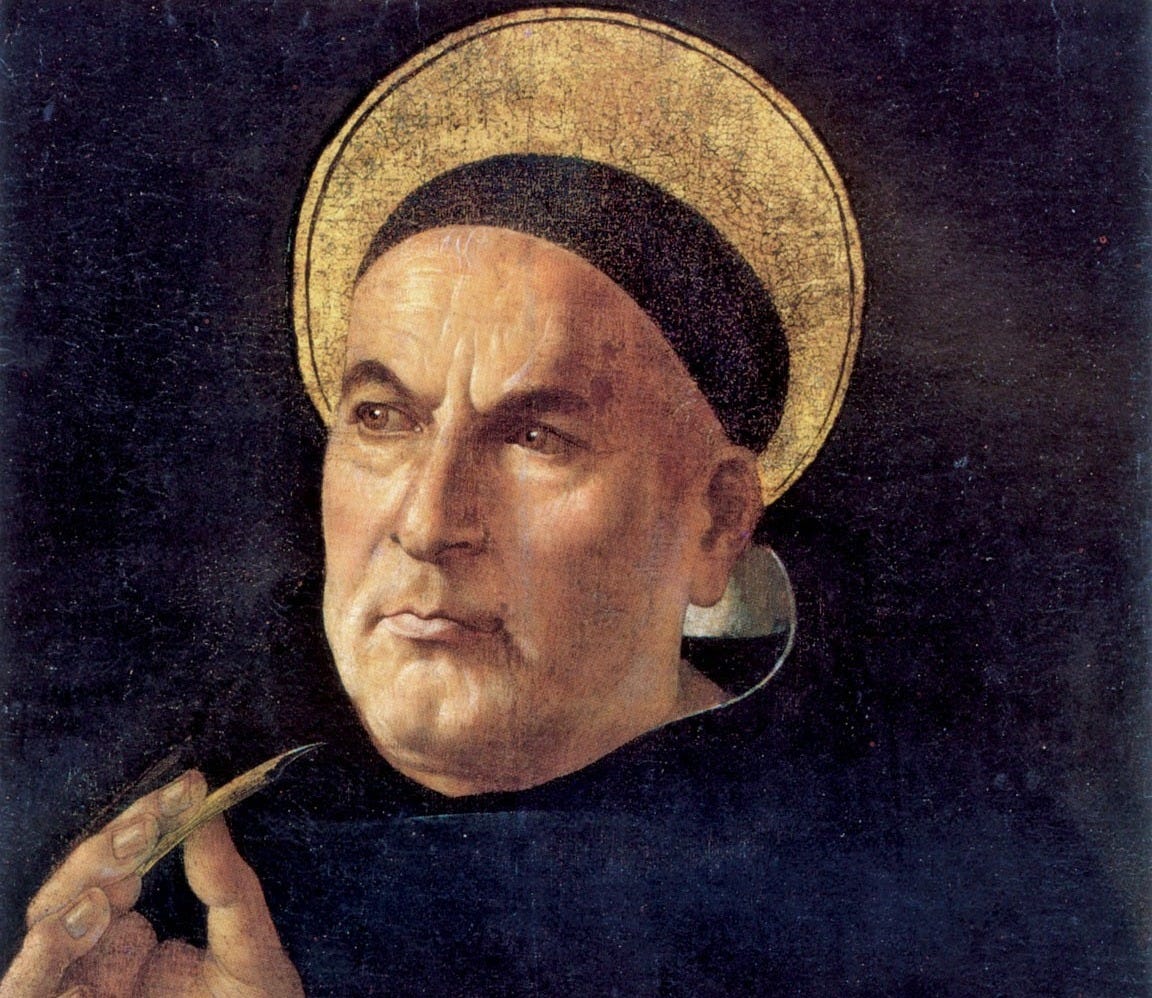
With that summary, we are now ready to consider the high mark of Christian metaphysics that is medieval Scholasticism. Many things have been said about this granite edifice of Western learning. Among them, it is described as a grand baptism of Aristotle. Scholasticism is largely Christian Aristotelianism. This is especially said of the great summa of scholasticism that is the work of St. Thomas Aquinas.
Hence, and for the sake of brevity, I will focus on Aquinas in what follows. The task ahead will not be the fool’s errand of comprehending in one post the whole of Thomism, or worse, the whole of Western medieval philosophy, but to establish points of comparison between it and the mimetic Christian anthropology as I’ve so far outlined. After all, Girard himself seems conscious of his work’s disruptive effect on high Catholic metaphysics when he says:
I base my arguments on the Gospels, rather than on Saint Thomas Aquinas or on Aristotle. That’s why I have the fideists, the ones who say, ‘I believe because it’s absurd,’ against me, as well as the old Catholics who cite Aristotle at the drop of the hat but never the Gospels.
At the heart of Thomism is an Aristotelian analysis that historians of philosophy call “faculty psychology.” It is St. Thomas Aquinas’s mapping of the human essence into different faculties. He works from Boethius’s definition of the person as “an individual substance of a rational nature.” The definition already suggests what’s been criticized as an essentialization of the human from Eastern Christians but also Western ones: the turning away from the person as the who and toward essence as the what. St. Thomas is in the Aristotelian spirit when he sets off on a project to anatomize the human soul, albeit in a way that conforms to Christianity. The spirit is there in his penchant for classifying virtues and defining them as the golden mean. Let’s now brave a short Thomist faculty psychology, if only to evoke that spirit here.
Aristotle divides the soul into three layers: nutritive, sensitive, and rational. Plants have nutritive only, animals nutritive and sensitive, and humans all three. Similarly, Aquinas proposes two sensitive appetites: concupiscible, after easily obtained goods like food and bodily comfort, and irascible, which is after the same goods but is activated when they are hard to obtain and produces secondary goods like honor, justice, or victory. Then there is the rational appetite: the will. It is after universal rather than “selfish” goods like truth, virtue, friendship, and beatitude.
Aquinas then sets up eleven passions. Six passions are linked to the concupiscible appetite: love and hate, desire and aversion, and joy and sorrow. Five passions go under the irascible appetite: hope and despair, daring and fear, and anger, which has no opposite. There are then four cardinal virtues that rule these passions: temperance rules the concupiscible, fortitude the irascible, justice and prudence (in a qualified sense) the will. Aquinas then develops other virtues as subtypes of the four cardinal virtues.
In all this, we see the quintessential Aristotelian pursuit of entelechy. Aquinas is the scientist of the human soul. So far, his psychology involves no God nor external models but treats the soul as a machine with functional parts that make it work properly, or, if misused, lead it to dysfunction. However, surely, he must involve God somewhere and somehow. He does this by introducing three theological virtues on top of the four cardinal ones: faith, hope, and charity. These he considers virtues infused by God. They are the antennae of the human machine that receive God’s grace. Now, if you’re wondering how it is that man must have faith to receive God, yet faith is a virtue infused by God, you’ve stumbled into the livewire issue of the Reformation. But for now, let’s move on.
It should be clear now that the Aristotelian focus on immanent entelechy – on what is inside a nature or substance or essence under consideration – de-emphasizes that which is transcendental. It has been apparent to those who reacted or criticized Thomism over the centuries, over which it nevertheless became the cornerstone of Catholic theology.
Reactions set in right away. The first reaction, in the next century (14th), was the voluntarism of Duns Scotus and William of Ockham. They argued that Aquinas’s essentialism is too extreme, that it limits God’s will to logically necessary strictures of nature. They argued that God’s will is primary and sovereign, and that God could have chosen to make natures some other way, or any way he wanted. This reaction too will come to a head in the Reformation.
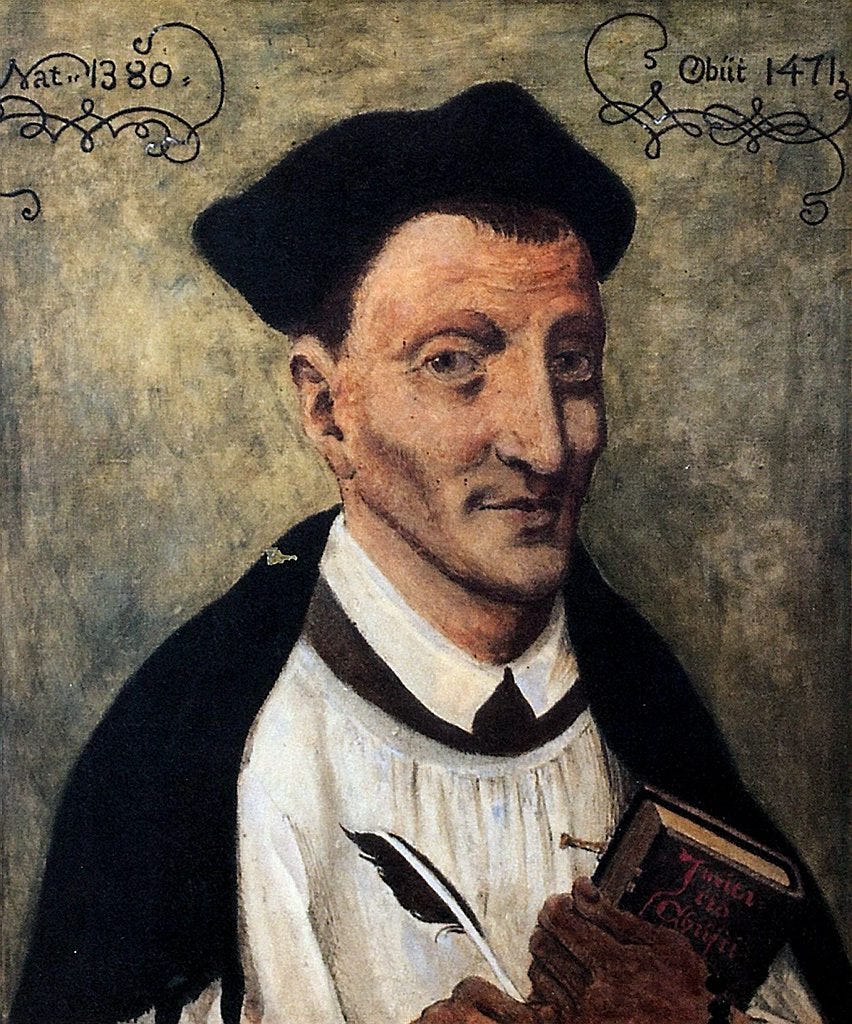
The next reaction came in the century after, and was against both Aquinas’s intellectualism and Ockham’s voluntarism. It was the immensely popular book Imitatio Christi by Thomas à Kempis, which emphasized simple, personal devotion over intellectualization and speculation.
Finally, the criticisms as well as the defense of Thomism continues in our day. I find that much of the apologia of Thomism centers on arguing that St. Thomas was not as Aristotelian as most presume. They point to his Platonist visions of participation, the fact that St. Dionysus (or Pseudo-Dionysus), a patristic father with the most elaborate Platonic vision of Christianity, was the second most quoted source in Aquinas, right after St. Augustine. Some point to the mystical experience Aquinas had three months before the end of his life, after which he stopped writing and famously said, “all that I have written seems like straw to me.” But the fact that they must mount defenses proves that the rise of the Aristotelian spirit was a consequence of Thomistic preeminence, whether intended by the saint himself or not.
The power of Thomistic philosophy and the vehemence of the reactions against it testify that something monumental has happened. That something is the great Aristotelian shift from transcendence to immanence, which first happened with Aristotle himself against Plato. Now, in Christian metaphysics, the shift drew into contention the whole Christian faith and civilization. The shift, again, amounts to the rise of the scientific spirit. It draws with it a shift away from imitation, participation, celestial hierarchies, and interpersonal dynamics, and towards inner structure, immanent forces, and taxonomy.
This also meant a shift from a personal or heartfelt relationship with God to an intellectual one. The old asceticism of battling the passions is substituted by the asceticism of intellectual pursuit. The Greek word askesis means training or exercise and is related to the word athleticism. Here, too, the connection to the modern scientific mindset is clear.
There’s much good that can be said of the intellectual or scientific askesis. Much of it is what we generally associate with the good of science: expansion of the knowledge of the physical world and its mastery through technology, or its effectiveness against superstition. One can ascribe to it a form of spiritual humility too, a defence against spiritual delusion, in its determination not to presume and to insist on logical or demonstrative proof. G.K. Chesterton, in his book on Thomas Aquinas, has the saint say:
It is true that all this is lower than the angels; but it is higher than the animals, and all the actual material objects Man finds around him. True, man also can be an object; and even a deplorable object. But what man has done man may do; and if an antiquated old heathen called Aristotle can help me to do it, I will thank him in all humility.
Nevertheless, the Aristotelian method is inimical to mimesis. The cornerstone of mimetic theory is that man is a creature who knows not what to desire, while the whole project of something like faculty psychology is to determine, enumerate, and fix the objects of human desire. Aquinas’s psychology gives the passions a place in the psyche and an impersonal aim, a bonum. Mimetic theory makes passions float and then fixate on others, and their aim is personal: Christ, or the saints who imitate Him, or, in the disordered form, the devil and his soldiers. Aquinas seems to propose a proper and final end for a human, a concretely defined end, which, in mimetic theory, sounds like believing in the pot at the end of the rainbow.
To the extent that science masters essences, it loses sight of the ungraspable, hypostatic, and relational persons. The price of the fruits of science over the broad sweep of history seems to be the diminishment of personhood.
Asceticism or athleticism is inseparable from competition, or what the Greeks, in somewhat sacral terms, would term agonistic strife. Early Christian monks battled demons, spiritual archetypes of the model-obstacle. It is worth asking, then, if there’s any rivalry to be associated with the intellectual athleticism of the Scholastics – other than, of course, the never convincing “battle against ignorance.” The answer to this mimetic question is that yes, there was.
Muslim scholars from the 10th to 12th centuries – Al-Farabi, Avicenna, and Averroes – developed Aristotelean theology to proof their new faith. Jewish scholar Maimonides performed the Jewish-Aristotelian synthesis. Medieval Christian theologians had to respond within the same framework as a defense of their own religion. We can go back to the beginning and say that Aristotle himself developed his science in agonistic strife with his august model-obstacle, Plato. Intellectual strife was always agonistic, from Aristotle to present-day geopolitical arms races. Among the Schoolmen, we see competition in the excessive intellectualization of dogma – “How many angels can dance on the head of a pin?” We see it in the formation of the universities, institutions to gather universal knowledge under one roof, and that competed amongst each other in doing so.
Intellectual competition reinforced the intrinsic blindness to mimesis, the one that springs from focus on immanent essences. Competitors imitate each other in their effort to outdo each other, yet they cannot acknowledge that imitation because that would amount to admitting defeat. For intellectual competition, this leads to ever greater focus on nature or autonomy, and ever greater blindness to suggestibility and interdependence. Yet, the same competition gives rise to modern science.
This raises the great historical question of why modern science arose in Christian Europe rather than anywhere else. Specifically, why did it not arise in the Islamic caliphates that embraced Aristotelianism before Europe did? To this may be added the mimetic question of how Christian Europe managed to turn intellectual competition into a transformative rather than a destructive enterprise, seeing that all societies prior to it either dreaded competition or, at most, channeled it into static ritualized institutions (like Greece or Rome, for example)?
The answers of serious historians of science (like Pierre Duhem and Stanley Jaki) have everything to do with theology. Modern science arises out of Medieval Scholastic clashes. Excessive Aristotelianism of the Schoolmen was condemned as heresy by the Bishop of Paris in 1277, on the grounds that it implied that created essences are logically necessary, so that God could not have made them otherwise. I’ve already mentioned the voluntarist reaction to this by Scotus and Ockham, who argued that God could have made the universe any way he pleased. It was this openness to contingence of voluntarism, in tension with the Aristotelean instinct to find logic in nature, that invited the empirical, observational activity among European scholars. Since we cannot deduce from first principles what the universe must be like, but since it ought to have some logic to it, let’s take a look and see if we can discover that logic.
As it turns out, Islamic Aristotelianism also suffered a condemnation in Muslim lands. It came in the form of a 1111 A.D. volume titled The Incoherence of the Philosophers (Tahāfut al-Falāsifa) by a Baghdad scholar named Al-Ghazali. The criticism was essentially the same as that in Europe: the Aristotelian “falasifa” restricted God too much by arguing for the eternity of the world, for preeminence of universals, and against bodily resurrection. Al-Ghazali defends Ash’arite occasionalism, which, similar to European voluntarism, argues that the connection between cause and effect is at the discretion of God, and is perceived as necessary by the human mind only by habit.
Unlike in Europe, however, Al-Ghazali’s theology, or kalam, triumphs completely over the philosophers. Al-Ghazali’s Islamic understanding of the sovereignty of God’s will is much stricter than the Christian one. Natural events are God’s direct action, not the operation of stable natures. If fire doesn’t burn cotton by its own nature but only because God wills the burning at each moment, there are no laws of nature to discover. In the words of E. Michael Jones:
Abu Hasan al-Ashari (873-935) viewed God “as pure will, without or above reason.” He then turned reason against reason by making God’s word an expression of his will rather than an expression of his reason or Logos. Logos thus began a slow process of evaporation from the Islamic universe. As a result of this turn against reason, “there is no rational order invested in the universe upon which one can rely, only the second-to-second manifestation of God’s will.” Reality becomes incomprehensible and the purpose of things in themselves indiscernible because they have no inner logic. If unlimited will is the exclusive constituent of reality, there is really nothing left to reason about. God became an exalted Caliph, who, as Maimonides put it, didn’t know if he were going to turn to the left or the right when he left the palace grounds on the ride he took in his carriage every afternoon. Science was reduced to the equivalent of reading the mind of a superior being who had not made up his own mind.
Consequent to such theology, Islam abandons philosophy in any institutional form.
Yet, a question arises as to why Ancient Greece itself did not produce empirical modern science, nor Ancient Rome, nor any other civilization outside Christendom? What they didn’t have, I propose, is what I’ve called the recession of the violent sacred brought about by the Gospel revelation. Archaic gods certainly were violent – they were bloodthirsty. Aristotle’s god was not bloodthirsty, but he was haughty and self-absorbed. The God of Islam is merciful and compassionate, we’re told, but considering al-Ashari’s claims, he appears rather haughty too, and in reading Islamic scriptures, quite violent to boot.
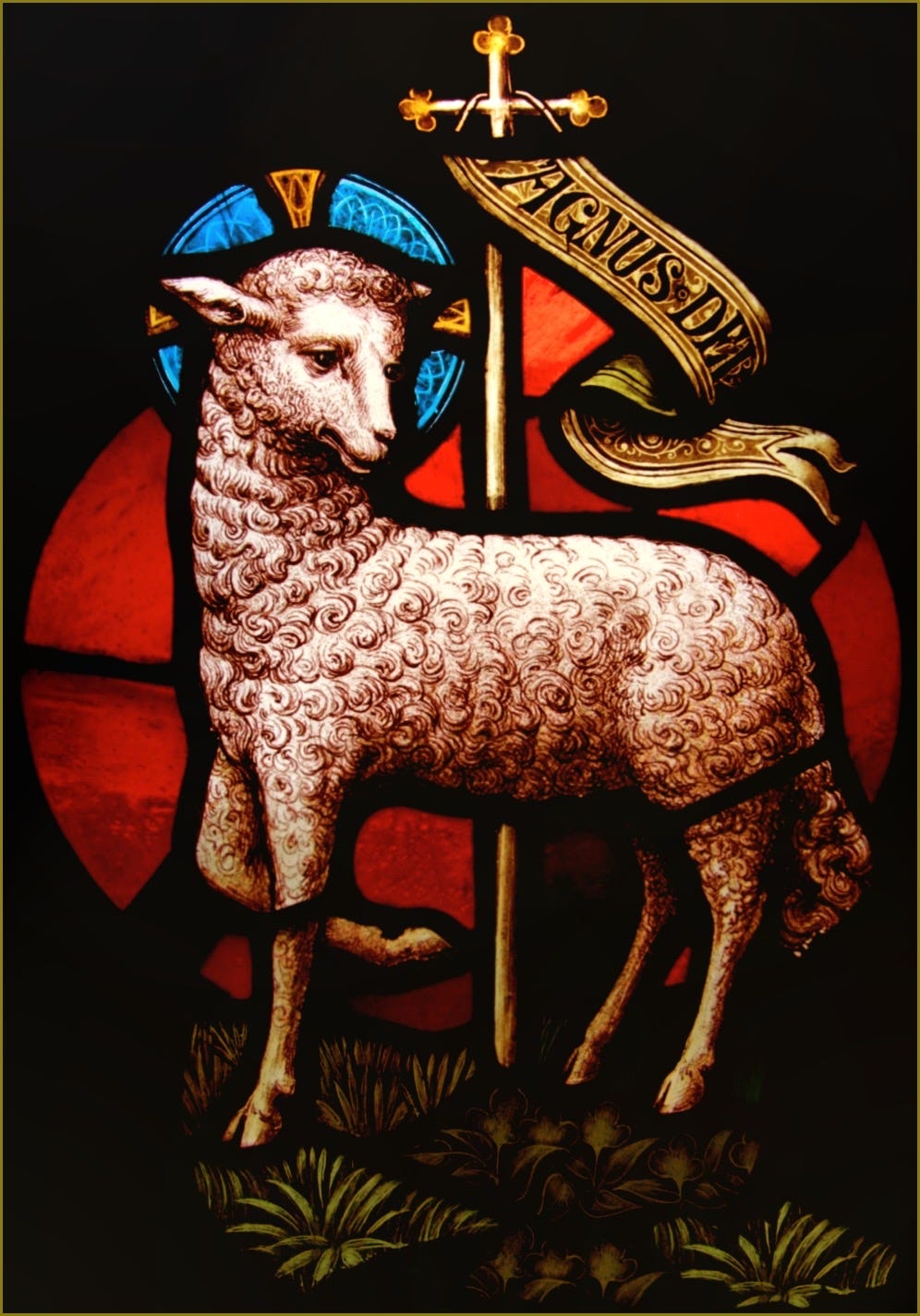
Outside Christianity, no god invites humans to come and see his works. No god invites them to imitate him, to become his friends, and to participate in his divine nature. The unique incarnational theology of Christianity, with the uniquely non-violent revelation of Jesus Christ, was the critical ingredient that pushed the Aristotelian and nominalist theologians both to investigate nature as his handiwork. Only in Christianity could such a project be seen as an imitatio Christi, an imitation of the Logos, who is the Lamb of God rather than a caliph, and the gentle master and creator of things visible. Everywhere else, a project would have been considered sacrilegious against jealous and vengeful gods.
“We didn’t stop burning witches because we invented science; we invented science because we stopped burning witches.”
- René Girard
Yet, we today know that modern science created its own spiritual challenges. It produced a collapse of mimetic, participatory, and personal aspects of the universe. It turned man himself into a profane object of scientific manipulation. At the same time, it turned him into the measure of all things, as Protagoras had said; it led him to a total incurvatio in se – St. Augustine’s (or Luther’s) “turning inwards to oneself,” the definition of sin. Thus, it created the great double-bind of the modern era: man as the Promethean hero, man as the lab animal.
In the next post, and probably the final one of the series, I will explore the diverse ways in which the modern scientific man attempted to resolve that double bind.